Right Plant, Right Place: What I Learned at a UF/IFAS Native Landscaping Workshop
Why successful South Florida gardens begin with careful observation before plant selection.
On October 10, I attended a workshop at the UF/IFAS Broward County Extension office in Davie called Florida-Friendly Landscaping with Native Plants in Southeast Florida, presented by Master Gardener Volunteer Janine Griffiths.
As someone who works with plants every day, I love opportunities to expand my knowledge, challenge my assumptions, and learn from people who share my enthusiasm for Florida's extraordinary plant life.
The workshop focused on incorporating native plants into residential landscapes, but the lessons went well beyond native gardening. They touched on something fundamental to every successful landscape: understanding the environment you're planting in.
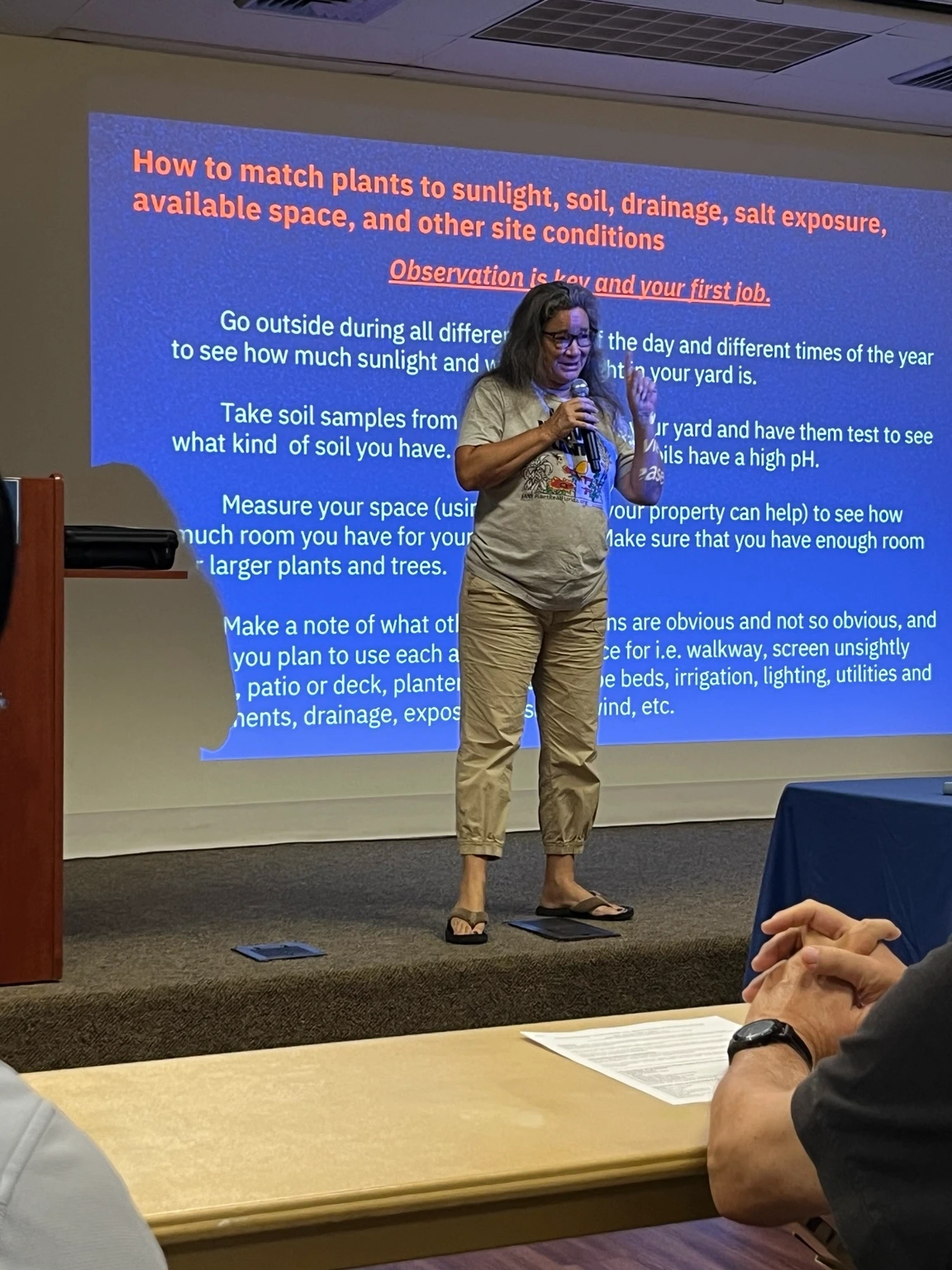
One of Janine's slides offered a simple instruction: "Observation is key and your first job."
That might be the most important gardening advice anyone can receive.
Before You Buy a Plant, Get to Know Your Yard
It's tempting to begin a landscaping project by choosing plants.
You visit a nursery, fall in love with something beautiful, and start imagining where it might go. Perhaps it's flowering spectacularly, or its foliage is just the color you've been looking for.
But the plant doesn't know what you have in mind.
It has its own requirements, and those requirements don't change just because we've found the perfect spot for it aesthetically.
Janine encouraged us to observe our properties at different times of day and throughout the year.
Where does the morning sun fall? Which areas receive the intense afternoon sun? Where does water collect after heavy rain? What happens when the seasons change?
In South Florida, these questions matter enormously.
A garden bed that receives full sun in summer might spend much of winter in the shadow of a building or mature tree.
Even within a single property, growing conditions can vary dramatically.
The Florida-Friendly Landscaping principle of Right Plant, Right Place recognizes that successful gardening begins by matching a plant's needs to the conditions where it will live.
And sometimes, that means choosing a different plant.
Every plant I've killed was a result of me putting it where I wanted to see it, rather than where it needed to be to thrive.
All plants thrive in their natural habitat and will do so with little interference from their human caregivers.
So it makes sense to understand the conditions the plant needs to thrive and finding the closest match to the habitat in your garden. The simplest place to start is sun versus shade.
Sunshine Isn't a One-Size-Fits-All Requirement
One of the examples Janine discussed was muhly grass (Muhlenbergia capillaris).
This beautiful Florida native produces clouds of airy cotton candy pink flowers that can transform an ordinary landscape into something spectacular.
But to achieve that spectacular flowering, muhly grass needs plenty of sunshine—ideally around six to eight hours of direct sun.
Plant it somewhere too shady, and you may get sad, floppy, green foliage without the dramatic display you were expecting.
Contrast that with Simpson's stopper (Myrcianthes fragrans), another Florida native.
Simpson's stopper tolerates a much broader range of light conditions, from full sun to partial shade. Its attractive foliage, fragrant flowers, and colorful berries make it a versatile addition to a wildlife-friendly landscape.
The lesson isn't that one plant is better than the other.
It's that each has a place where it can perform its best.
And knowing the difference saves time, money, and disappointment.
South Florida Soil: Sometimes the Problem Is Chemistry
Another fascinating part of the workshop concerned our soil.
Much of South Florida has sandy or limestone-influenced soil that can be quite alkaline, commonly reaching pH levels around 7 to 8.5 in some locations.
The pH scale measures how acidic or alkaline soil is. A pH of 7 is neutral; numbers above 7 are alkaline, while numbers below 7 are acidic.
Why does this matter? Because soil pH affects how readily plants can absorb essential nutrients.
Some plants are perfectly happy growing in alkaline conditions. Others prefer acidic soil and can struggle when their roots cannot access nutrients efficiently.
Roses, for example, generally prefer slightly acidic soil, often around pH 6 to 6.5.
That doesn't mean you can't grow roses in South Florida. It means you may need to pay closer attention to your soil conditions, plant selection, and management.
For plants with particularly strong acidic-soil requirements, growing them in containers with an appropriate potting medium may be more practical than trying to permanently change the chemistry of an entire landscape bed.
Janine recommended soil testing rather than guessing, and mentioned SoilKit as one available resource. And she grows her antique roses in containers where she can have complete control over the soil.
One important qualification: South Florida soils aren't all identical. Soil conditions can vary with location, fill material, construction history, and previous landscaping practices.
Test first. Treat second.
Is It Really the Soil?
One comment from the presentation particularly caught my attention.
Janine suggested that when plants are struggling, the soil often isn't the primary culprit.
Sometimes the real problem is how we're managing the landscape.
Too much water. Too little water. Poor pruning practices. Insect pests. Plants installed in inappropriate locations.
It's easy to assume a struggling plant needs fertilizer or a soil amendment, but adding products without understanding the problem can make matters worse.
A yellowing plant might be suffering from a nutrient deficiency, but it might also have damaged roots, inadequate drainage, or an irrigation problem.
The symptoms can look remarkably similar.
Before reaching for fertilizer, take a closer look at what's actually happening.
The lowest palm fronds naturally yellow before they fall. All the Epson salt in the world can't reverse this process.
"But It Was Only in a Three-Gallon Pot!"
This may have been my favorite practical reminder from the entire workshop.
The size of a plant when you purchase it tells you very little about how large it will eventually become.
A young tree in a three-gallon nursery container may eventually reach 30 feet or more. A charming little shrub may grow into a substantial hedge.
Plants don't remain the size they were when we fell in love with them.
And in South Florida's long growing season, some can grow astonishingly quickly.
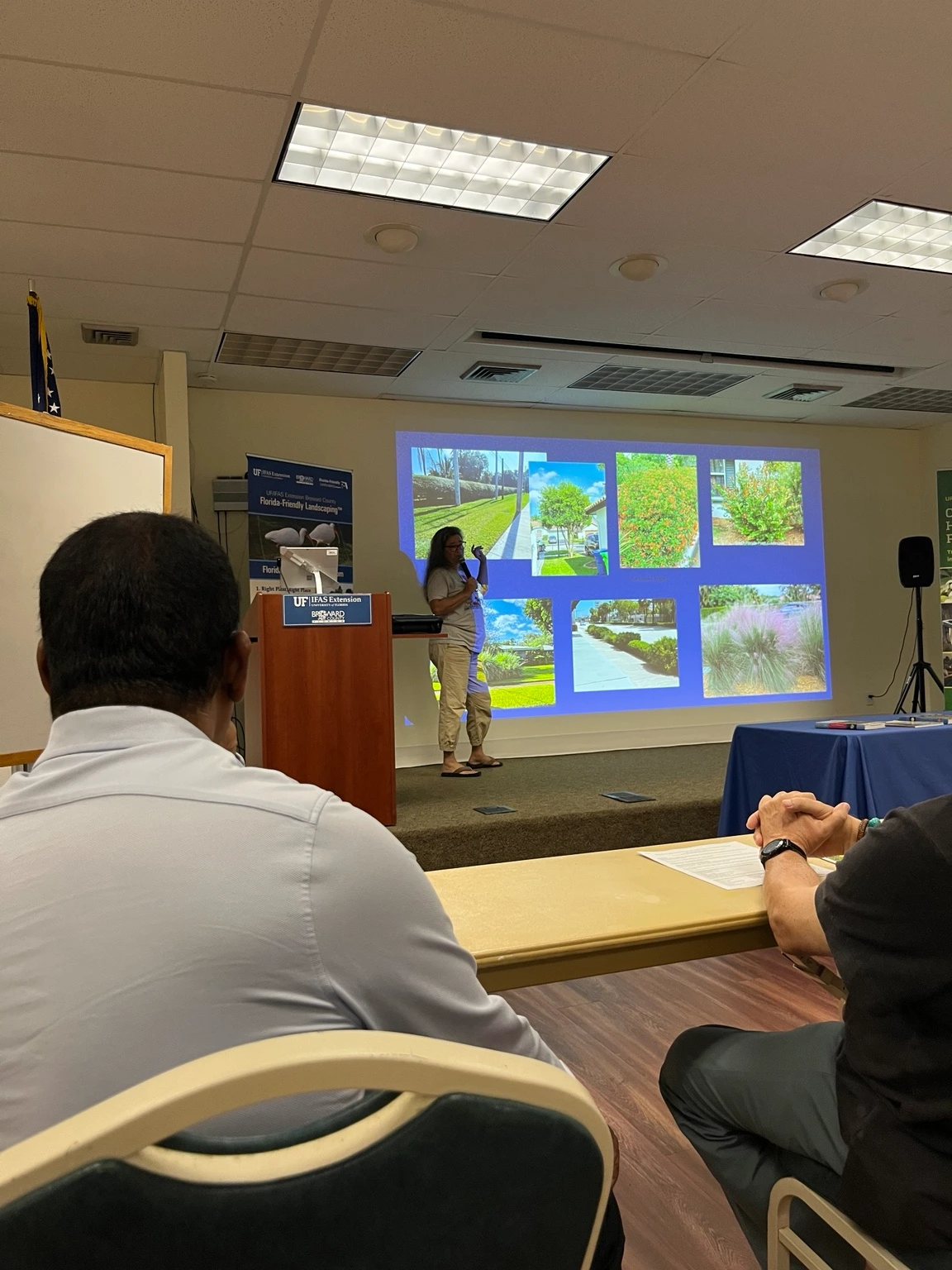
Before planting, consider the mature height and width, root space, distance from buildings, overhead utilities, walkways, and neighboring plants.
A plant that looks perfectly proportioned on installation day may be crowding a window or blocking a pathway a few years later.
Proper spacing also improves air circulation and reduces the need for constant corrective pruning.
The goal isn't to keep a naturally large plant small forever like a bonsai. It's to give it room to become what it's meant to be.
Ecological Benefits of Native Plants
A major focus of the workshop was the ecological value of native plants.
Florida's native plants have evolved within our regional ecosystems, developing relationships with insects, birds, and other wildlife over generations.
Some provide nectar for pollinators. Others produce berries, seeds, or fruit. Still others serve as host plants for butterfly and moth caterpillars.
Native vegetation can also provide shelter, nesting opportunities, and protective cover. So thoughtfully designed landscape can do much more than look attractive.
It can become part of the surrounding ecosystem.
Among the plants discussed were:
Simpson's stopper: Fragrant flowers, attractive berries, and flexibility in sun exposure.
Firebush: Tubular flowers that attract hummingbirds and butterflies.
Cocoplum: A versatile native shrub with fruit used by wildlife.
Dune sunflower: A cheerful, low-growing flowering plant suited to sunny, well-drained locations.
Sunshine mimosa: A low-growing native groundcover with delicate pink powder-puff flowers.
Muhly grass: A striking ornamental grass that provides texture and seasonal color.
Gumbo limbo: A distinctive native tree recognized for its peeling reddish bark.
Of course, native doesn't automatically mean maintenance-free, drought-proof, or appropriate for every property.
A plant native to a wetland may struggle in a dry, sandy planting bed. A coastal native accustomed to salt exposure may have very different requirements from a woodland species.
Once again, it comes back to choosing the right plant for the right place.
Nine Principles for a Florida-Friendly Landscape
The workshop also reviewed the nine principles of Florida-Friendly Landscaping, a program developed to help homeowners create attractive landscapes while conserving resources and protecting Florida's environment.
These principles are:
Right Plant, Right Place
Water Efficiently
Fertilize Appropriately
Mulch
Attract Wildlife
Manage Yard Pests Responsibly
Recycle Yard Debris
Reduce Stormwater Runoff
Protect the Waterfront
I appreciate that these principles are practical rather than prescriptive.
They don't demand that every yard look like a wilderness or that homeowners abandon their favorite ornamental plants.
Instead, they encourage us to make more informed decisions about how we design and care for our landscapes.
A Florida-Friendly garden can be formal or informal, colorful or understated, composed of natives and suitable nonnatives, or designed primarily around native species.
The underlying goal is a landscape that works with its environment rather than constantly fighting against it.
Saving Water Begins With Plant Selection
Water conservation was another important theme.
Janine discussed several straightforward ways homeowners can reduce unnecessary irrigation.
One is grouping plants with similar water requirements together, a practice sometimes called hydrozoning.
When drought-tolerant plants share an irrigation zone with moisture-loving plants, one group may receive too much water while the other receives too little.
Separating them makes watering more efficient.
Other suggestions included checking irrigation systems for damaged or misdirected sprinkler heads, using rain sensors, and collecting rainwater where practical.
These are relatively simple steps that can save water while improving plant health.
And sometimes, the most effective way to reduce watering is simply to select a plant already suited to the site's natural moisture conditions.
Gardening Is an Ongoing Education
One of the things I enjoy most about horticulture is that there's always something new to learn. Even familiar plants can surprise us.
A species that performs beautifully in one yard may struggle just a few streets away. A landscaping practice that seems logical may have unintended consequences for the surrounding ecosystem.
Workshops like this are valuable because they connect scientific research with the everyday realities of gardening in South Florida.
They also remind us that good landscaping isn't simply about knowing plant names.
It's about understanding relationships—between plants, soil, water, sunlight, insects, wildlife, and the people who live among them.
I left the workshop with some new information, a few reinforced convictions, and plenty of ideas to bring into my work at Inch by Yard.
But the lesson I keep returning to is the simplest one: Before deciding what to plant, take the time to understand where you're planting it.
Your garden will be better for it.
Resources for South Florida Gardeners
For anyone interested in learning more, here are several resources shared during the workshop:
UF/IFAS Gardening Solutions — Research-based information on plants, landscaping, and gardening in Florida.
Florida-Friendly Landscaping Program — Guidance on the nine Florida-Friendly Landscaping principles.
Natives for Your Neighborhood — A useful resource for identifying native plants suited to your South Florida location.
Florida Native Plant Society — Native plant education, conservation, and local chapters.
Florida Wildflower Foundation — Information about Florida's native wildflowers.
UF/IFAS Broward County Extension — Local educational programs and horticultural resources.
Special thanks to Janine Griffiths, Master Gardener Volunteer, and UF/IFAS Broward County Extension for providing this educational workshop.
At Inch by Yard, we believe successful gardens begin with the right plants and good information. We help South Florida gardeners choose plants suited to their spaces, growing conditions, and goals—bringing the garden store to your door.