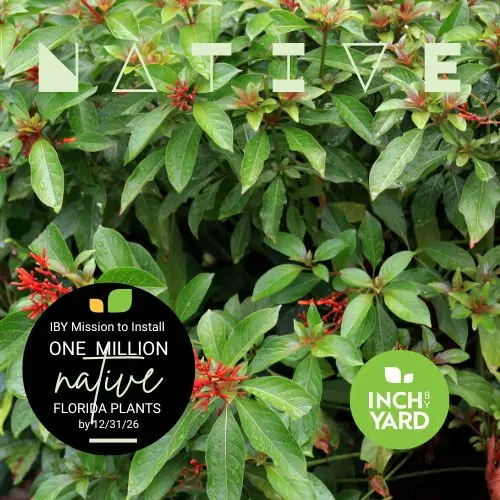
Firebush (Hamelia patens)
This plant can become part of your Family Tree. Earn Pollen with your purchase, follow your plants’ timeline in your account, and use eligible Pollen toward future orders. How Pollen & Family Tree work →
We upload photos of the actual plants selected for you to your order before they ship. You'll have the opportunity to see exactly what is being prepared.
Email hello@inchbyyard.com, call or text (954) 289-5848, or use the website chat. We respond within two business days.
Plants shipped by carrier are covered by our 48-hour National Live Plant Arrival Policy. Report arrival damage within 48 hours with photos; approved claims qualify for a replacement or refund. Plants delivered and installed by Inch by Yard have a separate 30-day Thrive Guarantee. Read the full Returns Policy.
- **Appearance**: Firebush is a perennial shrub that can grow anywhere from 3 to 10 feet tall, depending on the growing conditions. It has a bushy, upright form with dense foliage.
- **Leaves**: The leaves are dark green, lance-shaped, and can be up to 6 inches long. They are arranged oppositely along the stems and have a glossy appearance.
- **Flowers**: One of the most striking features of firebush is its tubular flowers, which are typically orange to red in color. These flowers bloom in clusters and attract a variety of pollinators, including hummingbirds and butterflies.
- **Fruit**: After flowering, firebush produces small, round berries that are usually dark purple to black when ripe. These berries are edible and can attract birds.
- **Climate**: Firebush thrives in warm, tropical, and subtropical climates. It prefers full sun to partial shade and is tolerant of drought once established.
- **Soil**: It grows well in a variety of soil types, including sandy and loamy soils, as long as there is good drainage.
- **Ornamental**: Firebush is often used in landscaping for its vibrant flowers and ability to attract wildlife. It can be planted as a hedge, in borders, or as a specimen plant.
- **Ecological**: The plant plays a role in local ecosystems by providing nectar for pollinators and food for birds.
- **Medicinal**: In some cultures, parts of the firebush plant have been used in traditional medicine, although scientific research on its medicinal properties is limited.
- **Pruning**: Regular pruning can help maintain its shape and encourage more blooms.
- **Watering**: While firebush is drought-tolerant, it benefits from regular watering during dry spells, especially when young.