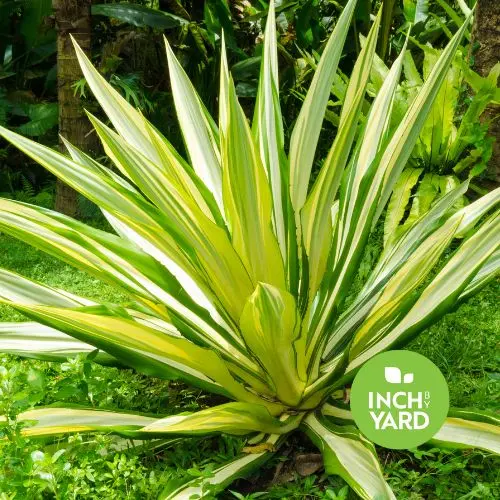
False Agave (Furcraea)
This plant can become part of your Family Tree. Earn Pollen with your purchase, follow your plants’ timeline in your account, and use eligible Pollen toward future orders. How Pollen & Family Tree work →
We upload photos of the actual plants selected for you to your order before they ship. You'll have the opportunity to see exactly what is being prepared.
Email hello@inchbyyard.com, call or text (954) 289-5848, or use the website chat. We respond within two business days.
Plants shipped by carrier are covered by our 48-hour National Live Plant Arrival Policy. Report arrival damage within 48 hours with photos; approved claims qualify for a replacement or refund. Plants delivered and installed by Inch by Yard have a separate 30-day Thrive Guarantee. Read the full Returns Policy.
- **Appearance**: False agave plants typically have long, sword-like leaves that can be green or variegated. The leaves are often fleshy and may have sharp edges or spines along the margins.
- **Growth Habit**: These plants can grow in a rosette form and can reach heights of several feet. They are generally more upright than true agaves.
- **Flowers**: When they flower, false agaves produce tall flower spikes that can reach impressive heights, adorned with clusters of small, tubular flowers. The flowering process can take several years and is often a dramatic event for the plant.
- **Native Range**: False agave species are primarily native to tropical and subtropical regions of the Americas, particularly in areas like Mexico and the Caribbean.
- **Growing Conditions**: They thrive in well-drained soils and prefer full sun to partial shade. They are drought-tolerant and can withstand dry conditions, making them suitable for xeriscaping.
- **Ornamental**: False agave is often used in landscaping for its striking appearance and architectural form. It can be a focal point in gardens or used in rock gardens.
- **Fiber Production**: Some species of *Furcraea* are cultivated for their fibers, which can be used to make ropes, textiles, and other products.
- **Watering**: These plants require minimal watering once established, as they are adapted to arid conditions.
- **Soil**: Well-draining soil is essential to prevent root rot. Sandy or rocky soils are ideal.
- **Fertilization**: They generally do not require much fertilization, but a balanced fertilizer can be applied during the growing season for optimal growth.
| Size: 3 Gallon |